
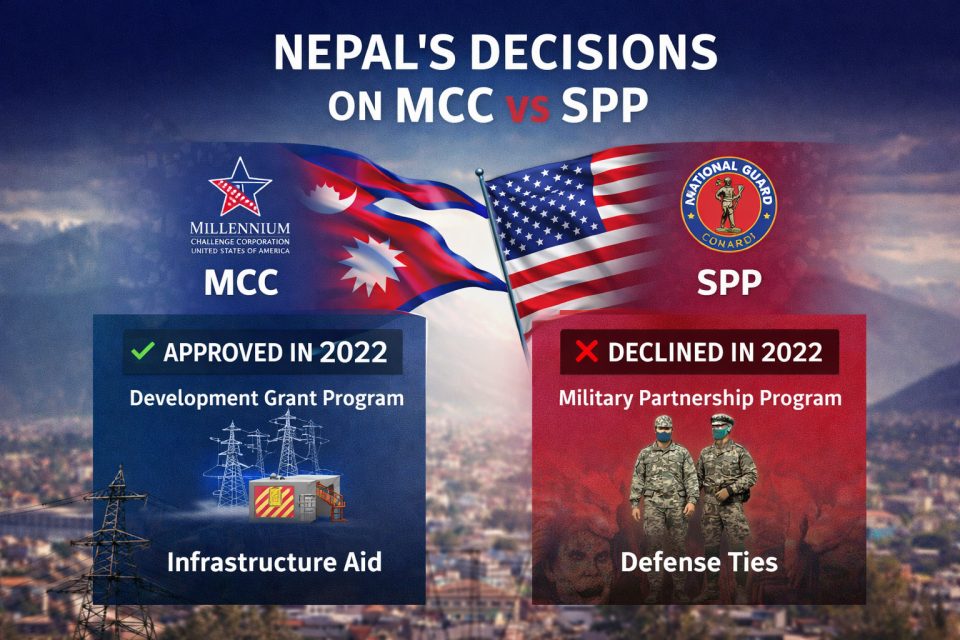
In recent years, there has been widespread discussion in Nepal about two United States–related programs: the Millennium Challenge Corporation Compact (MCC) and the State Partnership Program (SPP).
Many discussions on social media have linked these two programs together, creating confusion among the public. However, official documents and government decisions show that MCC and SPP are separate programs with different purposes.
Understanding the difference is important to avoid misinformation.
MCC: A Development Grant Program
The Millennium Challenge Corporation is a United States government development agency that provides financial assistance to developing countries for infrastructure and economic growth.
Nepal and the United States signed the MCC Compact Agreement on 14 September 2017.
Under this agreement, Nepal will receive USD 500 million in grant assistance from the United States. The Government of Nepal will also contribute about USD 130 million to the project.
The main goals of the MCC project in Nepal include:
Construction of about 315 kilometers of high-capacity electricity transmission lines
Development of substations
Maintenance and improvement of strategic roads
The project aims to improve Nepal’s electricity transmission system and support regional energy trade.
After several years of political debate, the Federal Parliament of Nepal ratified the MCC agreement on 27 February 2022.
SPP: A Military Partnership Program
The State Partnership Program (SPP) is a different type of program. It is run by the United States National Guard.
The program connects US National Guard units with partner countries to support cooperation in areas such as:
Disaster response and humanitarian assistance
Military training and professional exchange
Emergency preparedness
Joint exercises
More than 100 countries around the world participate in the SPP program.
SPP Proposal and Debate in Nepal
Discussions about Nepal potentially joining the SPP program started around 2015 through cooperation between the Nepal Army and US counterparts.
Later, the United States formally offered Nepal participation in the program.
However, the issue became politically sensitive in Nepal. Some political leaders, analysts, and civil society groups expressed concern that joining the program could be interpreted as a form of military alignment.
Nepal has traditionally followed a non-aligned foreign policy, maintaining balanced relations with major global powers.
Government Decision on SPP
Due to increasing political debate, the Government of Nepal made an official decision.
On 20 June 2022 (6 Ashar 2079 BS), the Council of Ministers decided not to move forward with the SPP program.
This decision clarified Nepal’s position regarding the program. The United States later stated that it respected Nepal’s decision.
Are MCC and SPP Connected?
One of the most common public questions is whether MCC approval automatically leads to SPP participation.
Based on available agreements and official statements, there is no legal requirement linking the two programs.
The key differences are:
MCC focuses on economic development and infrastructure
SPP focuses on military cooperation and disaster response
Because of these differences, they are considered separate initiatives managed by different institutions.
Conclusion
Nepal has taken different decisions regarding these two programs based on its national priorities and foreign policy considerations.
The country approved the MCC agreement to support infrastructure development and economic growth. At the same time, the government decided not to proceed with the SPP program due to political and diplomatic sensitivities.
A clear understanding of these facts can help reduce confusion and support more informed public discussion.
