
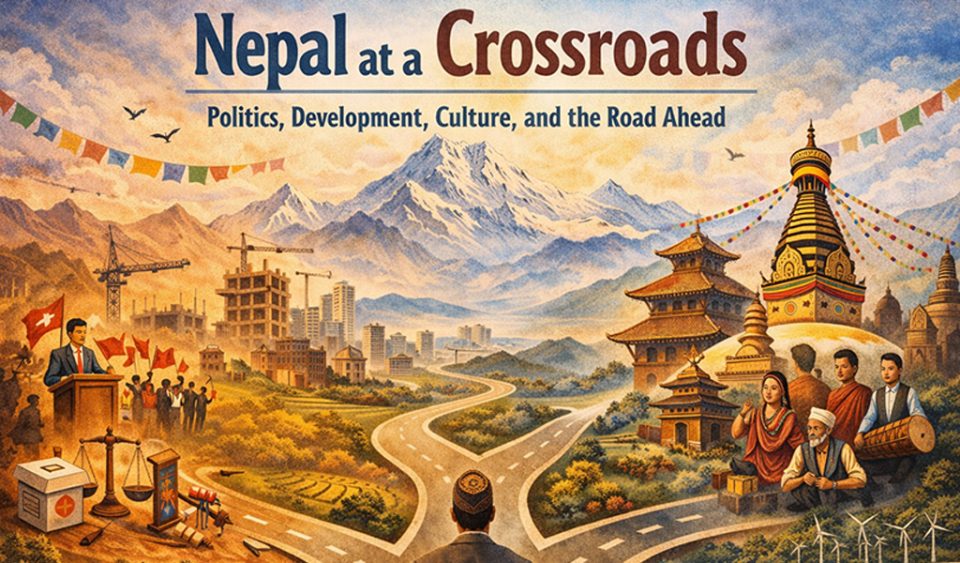
Nepal, a nation defined by towering Himalayan peaks and ancient civilizations, stands today at a crucial crossroads. Known as the birthplace of Lord Buddha and a living bridge between South and East Asia, Nepal carries a deep cultural legacy while striving to define its modern future. In recent years, the country has experienced notable development efforts, persistent political instability, rising nationalism, and renewed public debate about governance. Together, these forces are shaping Nepal’s present reality and future possibilities.
Political Landscape and Its Impact on National Development
Politics has played a decisive role in Nepal’s development trajectory. Since the abolition of the monarchy in 2008 and the establishment of a federal democratic republic, Nepal has undergone frequent changes in government. Coalition politics, leadership instability, and internal party conflicts have often slowed policy execution and long-term planning.
This political instability has had a direct impact on economic growth, infrastructure development, and public trust. Major national projects — including hydropower plants, highways, and industrial zones — often face delays due to changes in leadership, policy reversals, or bureaucratic uncertainty. Investors, both domestic and foreign, remain cautious when political continuity is weak.
At the same time, democratic freedom has allowed citizen activism, media independence, and youth participation to grow. Recent years have seen strong public reactions to corruption, governance failures, and controversial laws, especially among young people. Youth-led protests and digital movements have signaled a clear message: the new generation demands accountability, transparency, and performance-based leadership.
Political debates around federalism, governance efficiency, and even the role of the former monarchy reflect a society still searching for the most stable and effective governing model. While opinions differ, this ongoing dialogue itself demonstrates a politically aware and engaged population.
Economic Development: Progress with Political Constraints
Nepal’s economy has shown resilience despite political uncertainty. Agriculture remains a backbone of employment, while remittances from Nepalis working abroad contribute significantly to national income. However, over-dependence on remittance has also exposed vulnerabilities, highlighting the need for domestic job creation.
Hydropower is Nepal’s most promising strategic asset. With thousands of rivers and steep terrain, the country holds massive energy potential that could transform Nepal into a regional power exporter. Recent progress in electricity exports to neighboring countries reflects this opportunity, though political coordination and regulatory clarity remain essential to scaling this sector.
Tourism continues to be a vital economic pillar, driven by trekking, mountaineering, religious tourism, and cultural heritage. Political stability, infrastructure development, and international confidence are crucial for sustaining tourism growth.
Economic reforms often depend on political will. When governance is stable, development accelerates; when instability rises, progress slows. This connection between politics and prosperity is increasingly understood by the public.
Culture and National Identity: Strength Amid Change
Nepal’s cultural diversity remains one of its greatest strengths. With over a hundred ethnic groups and languages, the nation represents a rare blend of traditions, religions, and lifestyles. Festivals such as Dashain, Tihar, Losar, Chhath, and Indra Jatra reinforce social unity and national pride.
Cultural preservation has gained renewed attention, with efforts to protect indigenous languages, art forms, and heritage sites. Even amid modernization, Nepalis continue to value community, respect for elders, and spiritual balance.
National identity in Nepal is deeply rooted in independence, resilience, and dignity. Despite being landlocked between two powerful neighbors, Nepal has maintained its sovereignty and distinct identity for centuries — a source of strong nationalist sentiment.
Nationalism, Geopolitics, and Sovereignty
Nationalism in Nepal is closely tied to sovereignty and self-determination. Public sensitivity toward border issues, foreign influence, and national decision-making reflects a population protective of its independence.
Geopolitically, Nepal maintains a delicate balance between India and China. Strategic diplomacy is essential to attract investment, enhance connectivity, and protect national interests without compromising autonomy. Increasingly, policymakers and citizens agree that internal governance reform is more important than external alignment in determining Nepal’s success.
Future Possibilities: Youth, Stability, and Strategic Reform
Nepal’s greatest asset is its young population. With proper education, skill development, and employment opportunities, youth can drive innovation in technology, entrepreneurship, agriculture modernization, and creative industries.
The future depends on:
- Political stability and policy continuity
- Strong institutions and anti-corruption enforcement
- Investment in education, health, and infrastructure
- Sustainable use of natural resources
- Inclusive development across provinces
If politics evolves toward stability and accountability, Nepal has the potential to transition from a remittance-dependent economy to a production-driven, innovation-led nation.
Conclusion: A Nation Between Challenge and Opportunity
Nepal today stands between tradition and transformation. Political instability has slowed development, yet democratic awareness and youth engagement offer hope. Cultural heritage remains strong, nationalism continues to shape public discourse, and economic opportunities — particularly in energy and tourism — are real.
With responsible leadership, institutional reform, and citizen participation, Nepal can convert its challenges into strength. The nation’s future will not be defined by geography alone, but by the choices it makes — politically, economically, and socially.
Nepal’s story is still being written — a story of resilience, identity, and the pursuit of a more stable and prosperous tomorrow.
