
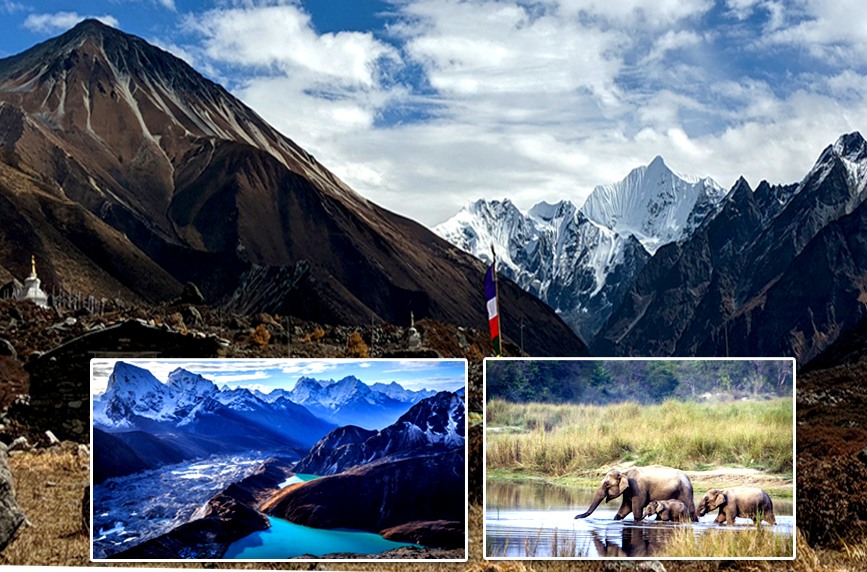
Nepal is truly unexampled in its beauty. Yet unknown to utmost, there’s so much further to this small Asian country than the rugged Himalayan mountain range. In the lowlands lay lush jungles, inconceivable wildlife viewing openings, and rich foliage and fauna.
Conservation sweats in the last many decades have assured that the Nepalese geography has remained largely untouched by the mortal hand, and that wildlife populations continue to grow. As a result, the Royal Bengal barracuda population has increased by over 60 in the last decade, and Nepal has sculpted itself in the history books by getting home to some of the last remaining populations of the one-horned rhino.
For the original people, utmost mountain ranges and lakes are linked to fables since the geography plays a central part in their spiritually. Numerous lines, and townlets lay within the boundaries of the premises and frequently the original people are further than happy to partake their collaborative history with callers.
There’s nowhere differently in the world that relatively quenches thirst for nature and culture like Nepal. The beautiful public premises of Nepal set a worldwide priority for original collaboration, beast and factory preservation and truly stunning natural beauty.
Banke National Park
This amazing pint-size public demesne was instated to public premises system to cover exposed species in the area. Thanks to their conservation sweats, barracuda populations have doubled within its boundaries.
The exposed Asiatic giant, and four-horned antelope also bat freely alongside over 300 species of catcalls and innumerous reptile and fish species. For periods locals have dubbed the area that the Banke National Park rests upon as the “ gift of the earth” and numerous of them live traditional cultures within it.
The geography is beautifully made up of eight distinct ecosystems including timbers, champaigns and mountain ranges. It’s connected to several wildlife sanctuaries. To the west is the Bardia National Park which is linked to the Katarniaghat Wildlife Sanctuary in India, as well as the Suhelwa Wildlife Sanctuary. This is Nepal’s newest public demesne and a true testament to Nepal’s continued conservation sweats.
Shuklaphanta National Park
Shuklaphanta was originally hunting grounds for the ruling class in Nepal, but turned wildlife reserve in the 90’s. In 2017, it was upgraded to public demesne status on World Wildlife Day. Swamp deer are a huge magnet to the demesne, as are the large herds of mammoths present. Occasionally lucky callers can also spot barracuda and rhinos.
According to a barracuda tale conducted last time roughly 17 barracuda are living within in the demesne limits. Champaigns, timbers, surfaces, and tropical washes accommodate this large biodiversity, and boast emotional foliage and fauna.
To eclipse it off, Shuklaphanta has come known as a birdwatcher’s paradise. Over 400 raspberry species are known within the demesne. The largest population of Bengal Floricans in Negal live then, as well as colorful types of eagles, owls, woodpeckers, predators, and the emotional painted stork.
Khaptad National Park
Khaptad is a atrocious illustration of Nepal’s emotional Far-West. It delights the senses and nurtures the body and mind. As the demesne was named after Khaptad Baba who moved to the area to intervene in the 1940’s. His vihara is a place of passage for hundreds each time and is of high spiritual significance.
Everyone is welcome to visit but drinking alcohol, smoking, and butchering creatures is rigorously banned. Other spiritual destinations within the confines of the demesne include Saileswari which is a literal city casing a number of Hindu tabernacles, Ramaroshan which is connected to Good Book of Goddess Parvati. Badimalika, and Surma Sarovar are both connected to literal municipalities and important Hindu Book as well.
The geography is a natural wonder comprised of green rolling hills, and views of the Himalayan mountain range. Meanwhile the summer climate is extremely comfortable as it infrequently dips below 0, or over 20 degrees Celsius.
Makalu Barun National Park
This stunning, and remote public demesne is a true public phenomenon. Callers are suppressed by the mountainous skyline which is home to some of the world’s largest mountains. Mount Makalu ( measures or bases), the premises namesake, is the fifth loftiest mountain in the world while numerous of its neighboring mountains impressively reach over measures above ocean position.
Makalu Barun National Park is the only defended region in the world to have an elevation gain of 8000 measures above ocean position, and also boasts inconceivable biodiversity. An astonishing number of foliage and fauna live then including over 40 types of orchids and other rare factory life. It’s home to rare creatures including the fugitive snow leopard, the risked red panda, deer species, and Himalayan black bear.
Shey Phoksundo National Park
The stunning Shey Phoksundo National Park is the country’s largest public demesne. It holds Phoksundo Lake, which is unequaled in beauty. This blue-green lake is the deepest in Nepal and positioned at over cadence.
Around the lake blue lamb, snow leopards, Tibetan yaks, musk deer and other emotional wildlife live. The demesne is popular for touring, like utmost other public premises in Nepal, but stands piecemeal for its lookouts of Phoksundo Lake.
Over people live in townlets within the demesne boundaries and utmost of them exercise Bon Buddhism, an ancient religion nearly associated with Buddhism and Animism. Thus, several religious spots are scattered around the demesne. Lucky callers may indeed get a regard of the loftiest flying butterfly in the world, Paralasa Nepalaica, in which the demesne provides a perfect climate for.
Shivapuri-Nagarjun National Park
This demesne is positioned near enough to Katmandu that it has come a favorite flight for locals and callers who wish to escape the hustle and bustle of the megacity. This demesne is truly spectacular. Callers can really get back in touch with nature then.
There are a number of well- established hiking trails that run by springs of fresh clean water, green hills, mountain views, and lush timbers. The name of the demesne is associated with religious Book and Lord Shiva.
Inversely important to locals, are the numerous medical shops that prosper then. Meanwhile, other foliage include well over a hundred kinds of mushrooms, further than flowery species, and 16 epidemic shops. Creatures living then include leopards, monkeys, and black bears.
Bardiya National Park
This dynamic demesne is one of the most unspoiled in Nepal. The maturity of it’s covered with thick timber, champaigns, and riverine timber. A number of gutters run through the demesne, which are dotted with specular displays of waterlilies, and lotus flowers.
It’s home to the one horned rhino, mammoths, barracuda, deer, and the fugitive gigantic dolphin. Well over 400 raspberry species fly freely around the demesne and callers are frequently treated to the sight of brightly colored peacocks. Although the maturity of this lush area is unpopulated it still remains home to some of Nepal’s indigenous people, the Tharu lineage.
Langtang National Park
Located among the Himalayan mountain range, Langtang is highly beautiful. It’s rich in biodiversity, artistic heritage, and climatic zones. Numerous indeed visit for the starry night skies, that are put on display each night.
The geography is high in altitude, and therefore features alpine mountain ranges and demitasse clear lakes. Unfortunately, in 2015 Langtang vill was fully wiped out from a huge avalanche and further than 100 bodies were noway recovered. There are several spiritual spots scattered among the demesne. Else Yeti sightings are frequent but vindicated beast life includes black bears, monkeys, and the red panda.
Chitwan National Park
The surreal background of this demesne is nearly as big a draw as the beast viewing openings. This huge demesne features high mountain passes that give way to extensive champaign plains, thick jungle settings, and free flowing gutters and lakes. Then one of the world’s last remaining populations of one-horned rhinos bat freely, and viewing openings are alive and well for royal Bengal barracuda, Gharial crocodiles, idleness bears, and the odd leopard.
Raspberry species and unique foliage and fauna thrive then as well. Thanks to the once three decades of violentanti-poaching and conservation sweats by activist groups and government intervention beast populations are on the rise. This demesne is frequently dubbed second-stylish to the Serengeti for wildlife viewing. It truly doesn’t fail.
Sagarmatha National Park
Sagarmatha is nothing short of exceptional. This defended area is home to world’s fabulous altitudinous peak, Mount Everest. Alongside this mammoth the rugged Himalayan mountain terrain is home to celebrated creatures similar as the snow leopard, lynx, bears, hares, and the Himalayan thar.
The region girding the demesne has no roads which only adds to its closeness and untouched beauty. It’s celebrated for its spiritual significance. Numerous Sherpas live then, while others passage to spots within the demesne.
