
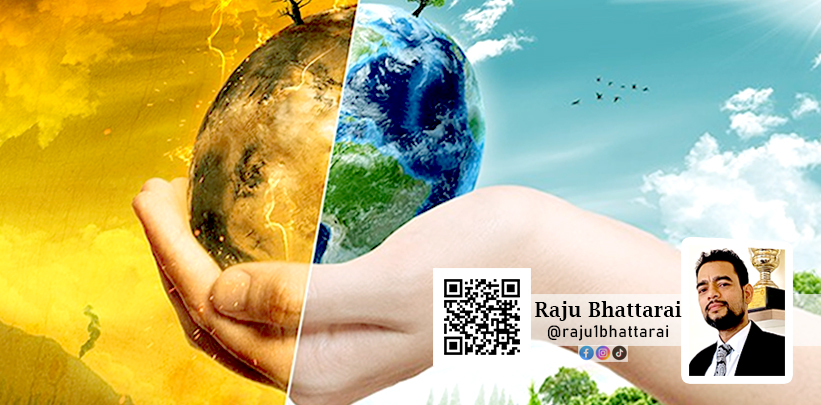
- Raju Bhattarai
“Humanity faces a stark choice: collective action for sustainability, or collective collapse.” – António Guterres, UN Secretary-General
The 21st century is not just another era of history—it is the decisive century for the fate of Earth. Never before has humanity held so much power over nature, and never before has our survival depended so directly on the choices we make today. From the forests of the Amazon to the rivers of Asia, from the ice caps of the Arctic to the air of megacities, our planet is sounding the alarm.
Sustainability is no longer an environmental debate—it is a civilizational imperative.
The Global Crisis in Numbers
The data is not just alarming—it is existential:
Biodiversity Loss: According to the WWF Living Planet Report (2022), global wildlife populations have declined by 69% since 1970. We are living in the midst of the sixth mass extinction.
Water Crisis: By 2030, global demand for freshwater will exceed supply by 40% (World Resources Institute).
Climate Emergency: The IPCC warns that without drastic action, global warming could reach 2.7°C by the end of this century, unleashing catastrophic floods, droughts, and famines.
Carbon Emissions: Despite pledges, CO₂ emissions reached a record 37.4 billion metric tons in 2023 (Global Carbon Project).
Ocean Decline: 90% of the world’s fish stocks are overexploited or depleted (FAO, 2020).
These are not isolated issues—they are interconnected crises that threaten the foundations of life: food security, health, stability, and peace.
Global Voices for Urgency
World leaders, scientists, and thinkers are calling this the most critical turning point in human history:
Barack Obama: “No challenge poses a greater threat to future generations than climate change.”
Pope Francis (Laudato Si’ 2015): “The Earth, our home, is beginning to look more and more like an immense pile of filth.”
Christiana Figueres (Paris Agreement Architect): “We are at the most important crossroads humanity has ever faced.”
Greta Thunberg: “I want you to act as if you would in a crisis. Because it is.”
These voices converge on one truth: the time for half-measures is over.
The Future: Sustainability as Civilization’s Core
The future of the world will not be defined by technology or economics alone—it will be defined by whether we embed sustainability into every system of life:
Energy Transition
By 2050, 90% of global electricity must come from renewables (IRENA, 2023).
Nations investing in solar, wind, hydrogen, and fusion will lead the next industrial revolution.
Food Security & Agriculture
Sustainable farming, plant-based diets, and circular food systems can feed 10 billion people without destroying ecosystems.
Wastage must end: currently, one-third of all food is lost or wasted (FAO).
Cities of the Future
By 2050, 68% of humanity will live in urban centers (UN).
Smart, green cities—powered by clean energy, with zero waste and resilient infrastructure—will decide the health of billions.
Water & Rivers as Lifelines
Civilization was born on riverbanks; its survival depends on protecting rivers.
Global cooperation on water-sharing will define peace and stability in Asia, Africa, and beyond.
Technology for Earth
Artificial Intelligence, biotechnology, and space science must serve sustainability—not profit alone.
From precision agriculture to carbon capture, innovation must align with survival.
The New Global Ethic: Living Within Limits
The age of limitless exploitation is over. The Earth operates on planetary boundaries—climate stability, biodiversity, freshwater, soil health, oceans. Crossing these thresholds risks collapse.
The challenge is not only scientific but moral. As philosopher Hans Jonas wrote: “Act so that the effects of your action are compatible with the permanence of genuine human life.”
The Path Forward: Collective Responsibility
Governments must embed sustainability into law, economics, and global treaties.
Businesses must shift from profit-driven to purpose-driven, aligning with ESG (Environmental, Social, Governance) frameworks.
Communities & Individuals must live consciously: saving energy, reducing waste, protecting rivers, planting green.
Youth & Education must become the frontline of change—because sustainability is not inherited, it is taught, lived, and passed on.
A Civilization at the Crossroads : The story of humanity has always been one of survival through adaptation. But today, adaptation is not enough—we must transform. Sustainability is not a choice among many; it is the defining choice between life and collapse.
“We are not above nature. We are part of it. To harm the Earth is to harm ourselves.”
Let this century be remembered not as the age of extinction, but as the age of regeneration. Let us promise: Save Green. Save Rivers. Save Earth. For when we save the planet, we save the only home we will ever know.
