
Ms. Puja Rijal
BBA Program
Global College International
Brief Introduction:
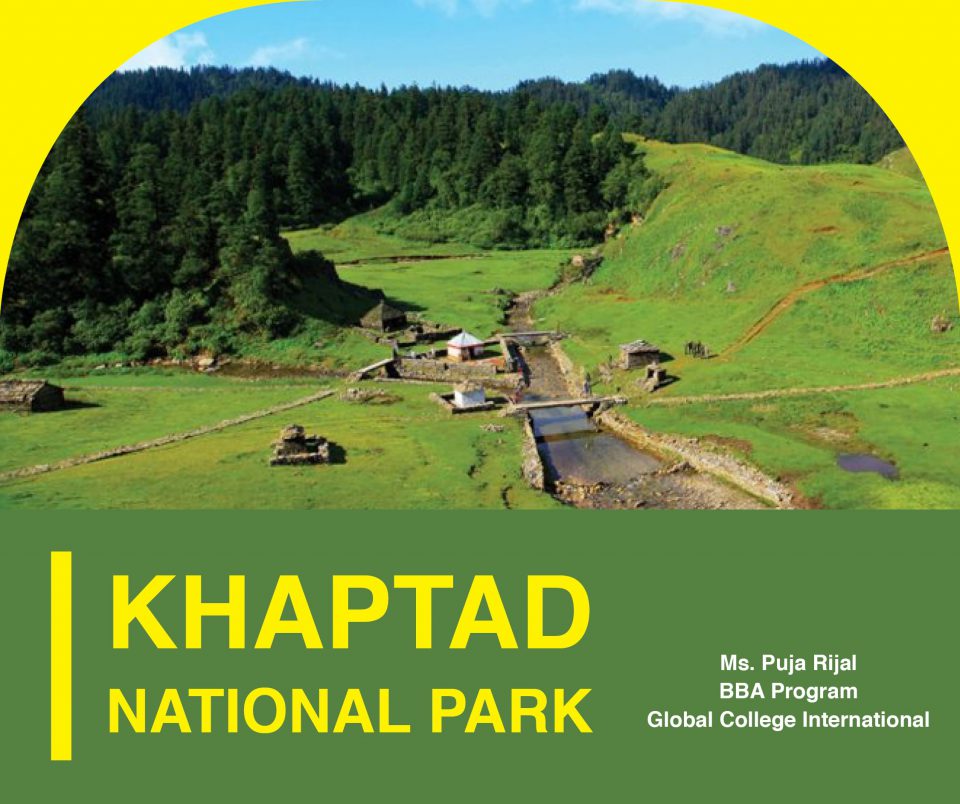
Khaptad, Nepal’s newest park area, is in the middle hills of the Far-West of the country. The 225 sq. Km/s. The area of the park is situated where the districts of Bajhang, Bajura, Doti, and Achham meet. Khaptad is a plateau of grassland and forest cover at an elevation of about 3,000 meters. The mixed conifer and broad-leaf forests are an excellent example of the vegetation that once covered much of west Nepal’s middle hills. The forest consists of a mixture of tall fir, yew, rhododendron, oak, dense stands of bamboo, and smaller shrubs.
This habitat provides good cover for bears, leopards, and musk deer, as well as birds like the Impeyan pheasant, koklass pheasant, and Kalij pheasants. This park is special because it represents one of the few remaining mid-mountain ecosystems in Nepal Himalaya. At the north-eastern corner of the park, a small serene lake and a swampy area called ‘Khapted Daha’ is a religious site where Hindu pilgrims come to worship Shiva on the full moon of July-August each year. Here lived the ascetic, the Khaptad Baba, who was known and revered throughout Nepal.
The Park offers a challenging yet rewarding experience unlike any other protected area in Nepal. The Khaptad Baba Ashram is located near the Park headquarters. The Tribeni confluence made by three rivers, and a Shiva temple are on the way to Park Headquarters. Ganga Dashahara is celebrated here during Jestha Purnima and many pilgrims visit the park during the festival. Sahasra Lingaa is another religious site situated at 3,200 m above sea level which is the highest point in the Park.
Other religious places include Ganesh temple, Nagdhunga, and Kedardhunga. These areas are considered places for meditation and tranquility and should not be disturbed. Tobacco products, alcohol, and sacrificing of animals are prohibited in these areas. There is a small museum and a view tower at the park headquarters. To the north one can see the API and Saipal Himalayan Ranges- In the other direction, the vast green mid-hills of Nepal can be seen clearly. The Park contains 22 open patches of grasslands or Patans interspersed with the forests. These Patans consist of gently rolling hills.
The local people graze their livestock in the Patans during the summer season. In the north-eastern part of the Park, there is a lake called Khaptad Daha. During the full moon of August – September a festival is held here.
History:
Khaptad Baba Ashram is located close to the park headquarters which is named after the late Khaptad Swami. Khaptad national park was established on the advice of the region’s spiritual saint Khaptad Baba. The renowned Khaptad Baba Ashram, a religious site where Hindu pilgrims come to worship Shiva, is located near the park’s headquarters. Khaptad Baba moved to the area in the 1940s to meditate and worship. He spent about 50 years as a hermit and became a renowned spiritual saint. Khaptad Baba Ashram lies inside Khaptad national park.
Khaptad National Park was named after the holy man, Khaptad Baba or Swami Sachchidananda. The Swami was a spiritual man who wandered/traveled along the high hilly/mountainous regions of Nepal. He is believed to have settled temporarily in parts of Ilam, Swargadwari, Kalinchowk, Mushikot, Chandannath, and finally settled in the Khaptad Valley.
Swami Sachchidananda moved to the now conservational area during the 1940s to worship and meditate. He is said to have resided in the valley for almost fifty years.
It was under his advice to Late King Birendra that the valley was later named the Khaptad National Park. The park still holds temples, hermitages, and stone statues of the holy man.
Present Scenario and Impact of COVID-19
The COVID-19 has dealt a severe blow to the nation’s burgeoning tourism sector. With Nepal lifting the travel restrictions and the limiting lockdown, the hospitality and tourism businesses have breathed a sigh of relief but are still reeling under the aftermath of the global pandemic.
In this regard, Khaptad, a major attraction of the Sudurpaschim Province has had to bear the maximum brunt of the declining number of visitors since the virus outbreak. There are hardly a handful of tourists to boast about within a week. “In a week, there are no more than two or three visitors to cater to. Although this isn’t the peak season, the scanty footfall is extremely worrying”. Many people have made tourism the source of income but due to the pandemic, it is creating a problem for their survival. There is no movement of people, lack of indoor and outdoor tourism lacks a source of income.
Most informal firms operate with limited savings, and owners may face the difficult choice of staying home and facing starvation during the lockdown or running their business and risking infection. These scenarios accentuate financial difficulties as well as the spread of COVID-19
The outbreak of the COVID-19 pandemic has brought uncertainty and spillover impact on almost all the sectors, and its enduring crisis on global tourism is a burning issue. Considering the intensity of coronavirus and its health impact, Nepal Government had to cancel the ambitious campaign “Visit Nepal Year 2020”. So this has an impact on the tourism of Khaptad also. Due to pandemic trekking, mountaineering, airlines, and other tourism sub sectors in Nepal are affected.
Meanwhile, the guideline for trekking, mountaineering, tour agencies has made; mandatory health declaration form (COVID-19 negative); maintaining personal hygiene; ensuring social distancing during the tour or trek; to following safety measures. Similarly, domestic & international flights will resume services following safe travel guidelines. All passengers will be required to take health precautions during flights.
Climate:
The climate in Khaptad National Park is cool and wet in summer and cold and dry in winter. The seasons of spring and autumn are the best times to visit the park. The monsoon begins in June and lasts until September during this time paths become muddy and slippery. From December to February winter brings snow and chilling winds.
Flora and Fauna:
The flora of the park can be divided into three basic vegetation zones-subtropical, and temperate. In the lower altitudes (1000 – 2000 m), subtropical vegetation dominates the landscape; Forest mainly consists of Montane Sal, Pines, and Alder species. From 1800 – 3000 m temperate type dominates the landscape. The forest there is composed of lower temperate mixed broad-leaved species (Lindera nausea, Cmn Amomum Tamca. etc.), temperate mixed evergreen species (Spruce, fir, hemlock, oak. etc), and upper temperate broad-leaved species (Aesc ulus indica, maple, etc.) Fir oak, birch, and rhododendron are the major species found there. Intertwined into the landscape of the Khaptad plateau are the Patans (pastureland) with beautiful flowers (about 135 species) that bloom in the summer and late spring. The grassland flowers consist of primulas, buttercups, and wild berries. A wide variety of medicinal herbs (about 224 species) occurs inside the park The park is reported to have 266 bird species with migratory birds joining the residential ones. It supports about 175 breeding bird species. Some of the common ones are the Impeyan, pheasant (Dhanphe), Nepal’s national bird, and many types of partridges, flycatchers, bulbuls, cuckoos, and eagles. A wide variety of butterflies, moths, and insects are also forming a part of the Khaptad ecosystem. The park provides a habitat for some 20 different species of mammals. Common ones include barking deer, wild boar, goral, Himalayan black bear, Yellow-throated Marten, and Rhesus and Langur monkey. Others include leopard, wild dogs, jackal, and musk deer.
Religious Sites:
Famous sites with religious as well as cultural importance incorporated by the park invite thousands of pilgrims each year Sahashra Linga, Ganesh temple, Nagdhunga, and Kedardhunga are the religious sites present in the Khaptad national park. The Sahasra Linga is also the highest elevation in the park with an altitude of 3200m.
These areas are considered places for meditation. In the northeastern part of the park, there is a lake called Khaptad Daha. During the full moon of August-September, a festival is celebrated here called Purnima. Ganga Dashahara is celebrated here during Jyestha Purnima and many pilgrims visit the park during the festival. On the way to the park headquarters, at the confluence of three rivers, known as Triveni a lord Shiva temple is located.
Tourism:
Khaptad national park is described as a living garden of herbs and a museum of natural history for its 224 species of medicinal herbs. It consists of moorland, Steep slopes, and streams. It also consists of a large variety of Flora and Fauna. Khaptad is beautiful trekking that gives us a break from our mundane life offering us a huge variety of natural diversities. The most favorable month for this trek is from March to May and from October to November. Khaptad is known as the well-hidden treasure of Nepal is famous for trekking, Khaptad Lake, cultural tours including religious Sightseeing, bird watching, meditation, and mountain viewing. The gateway to Khaptad is Silgarhi Bazaar in the Doti district. The best way to reach Silgarhi is via Atta Riya Chowk in Kailali district. Another option is to catch a flight to Dhangadi from where one can drive to Siliguri. A small museum at the headquarter introduces visitors to the park. Close to the headquarters, a view tower offers a beautiful landscape of the Api- Saipal Himalayan range. In the other direction, the vast green mid-hills of Nepal can be seen closer.
HOW TO GET THERE:
By Air: Travelers can directly reach Dhangadhi Airport in Nepal and from there they have to take a local taxi to Bajhang. From Bajhang, the trek starts to reach the national park.
By Bus: Buses from India also go directly to Dhangadhi, from where travelers will have to take 9 hrs. to reach Bajhang. From Bajhang, the trek starts to reach the national park.
Accommodation:
There are very few lodging options available around the national park. If travelers can find a few lodges in their way, the National Park at Dipayal and Silgadhi. The lodges are not very expensive. Since Khaptad National Park is a trek, many travelers choose to camp. The guest houses and the army barrack at the park take care of the park and the visitors. They provide a place and food, but if travelers are in the mood to camp they should carry their gear and food.
There are some hotels near the entrance gate Lokhande and Jhigrana. Inside the Park, there are two hotels and lodges with basic facilities. One 20 beds hotel at Khaptad and 10 beds hotel at Bichpani. Trekkers are advised to carry some food, sleeping bags, and warm clothes during the visit. In Jhigrana village there is a guesthouse run by a local family. The guesthouse has 3 rooms and can accommodate 6 persons at once. The rate is NPR 500/person.
Park Regulations to follow or things to remember:
• An entry fee of Rs.1, 500 (Foreigners), Rs.500 (SAARC Nationals), and Rs.100 (Nepali) visitors should be paid at the designated ticket counter.
• Valid entry permits are available from the National Parks ticket counter at the Nepal Tourism Board, Bhrikuti Mandap, Kathmandu, or the park entrance gate.
• The entry permit is non-refundable, non-transferable, and is for a single entry only.
• Entering the park without a permit is illegal. Park personnel may ask for the permit, so visitors are requested to keep the permit with them.
• Get a special permit for documentary/filming from the Department of National Parks and Wildlife Conservation (DNPWC).
• Documentary/filming fee of US$ 1500 (Foreigners), Rs. 50,000 (SAARC Nationals) and Rs. 10000 (Nepali) should be paid at DNPWC. An additional 25% should be paid while using a drone for documentary/filming.
• Drone (UAV) fee is the same as documentary/filming fee while using it for other purposes.
• Don’t remove or damage plants and animals. All flora and fauna are fully protected and must not be disturbed.
• Rubbish must be placed out, buried, or disposed of in designated areas.
• No one should walk within the park between sunset and sunrise.
• Do respect the cultural and religious sites.
• Camping inside the park should be made only at the designated areas.
• Carry out non-biodegradable items such as batteries, plastic bags, and bottles.
• Never trek alone, hire a local guide if you can’t find a companion.
Use of Park’s revenue:
30-50 percent of the park’s revenue goes directly to the Buffer Zone Communities for:
● Biodiversity Conservation Program
● Community Development
● Conservation Education
● Income Generation and Skill Development
Conclusion:
Khaptad is the land of the beautiful far west that many have heard of and want to visit. Spiritual, yoga, and meditation destination. When you reach the beauty of the place and the beautiful courtyard of nature, the mind becomes light. Khaptad is home to more than 200 species of colorful flowers, about 400 valuable herbs, 18 species of terrestrial animals, 372 species of flora, hundreds of species of birds, as well as musk deer, wood bears, wildebeests, leopards, vassals. This place, which is made fun of by nature, has a large grass field, small mounds, and a pleasant forest.
