
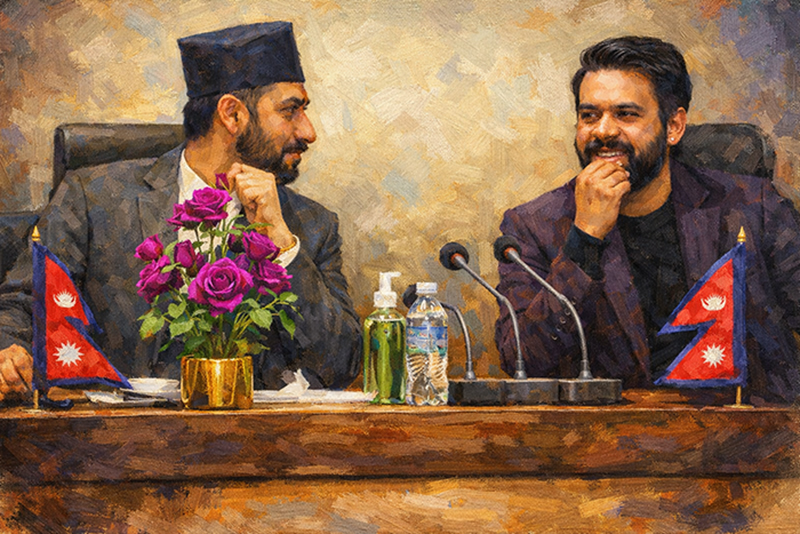
Nepal is standing at a critical political crossroads. Public frustration with traditional politics, increasing youth participation, and growing demands for accountability have created an environment where alternative leadership is no longer a choice but a necessity. In this evolving landscape, two names consistently dominate national discourse – Balendra “Balen” Shah and Rabi Lamichhane.
Recent media narratives and public discussions suggest a growing curiosity — and hope — around whether these two influential figures could move forward together for Nepal’s development. While no formal alliance has been declared, the idea itself reflects a deeper transformation underway in Nepali society.
A Changing Political Consciousness : The rise of Gen Z and young voters has significantly altered Nepal’s political dynamics. This generation is more informed, digitally connected, and vocal about governance, transparency, employment opportunities, and institutional reform. Unlike previous generations, today’s youth are less loyal to political symbols and more focused on performance, integrity, and results.
This shift has weakened blind party allegiance and opened space for leaders who speak directly to public concerns — a space where both Balen Shah and Rabi Lamichhane have found strong resonance.
Balen Shah: Symbol of Independent Leadership
Balen Shah emerged as a powerful symbol of change through his independent victory as Mayor of Kathmandu. His leadership style — direct, data-driven, and uncompromising on governance issues — positioned him as a leader outside traditional political frameworks.
What sets Balen apart is not just his administrative actions, but his ability to connect with youth sentiment. He represents the idea that leadership can come from competence rather than party legacy. While he has repeatedly distanced himself from national power ambitions, his growing influence has naturally placed him at the center of broader political conversations.
Rabi Lamichhane: Organized Alternative Politics
Rabi Lamichhane’s political journey reflects the frustration of citizens who want institutional reform rather than symbolic change. Through the Rastriya Swatantra Party (RSP), he attempted to translate public dissatisfaction into a structured political force capable of contesting power within the system.
Lamichhane’s strength lies in organization, national outreach, and political negotiation. Despite controversies and criticism, his ability to mobilize support and challenge established parties has made him one of the most influential alternative political actors in recent years.
Why the Idea of Collaboration Matters
The growing discussion around Balen and Rabi moving forward together is significant — not because of confirmed political plans, but because of what it represents.
Unity of Independence and Organization:
Balen symbolizes grassroots credibility and administrative effectiveness, while Rabi represents political structure and parliamentary engagement. Together, they reflect a balance between idealism and pragmatism.
A Break from Old Polarization:
Their potential cooperation signals a shift away from traditional left-right or party-centric politics toward issue-based leadership.
A Response to Youth Expectations:
The idea resonates strongly with young citizens who are less interested in political rivalries and more focused on outcomes — employment, infrastructure, transparency, and governance reform.
Media Narratives and Public Expectations
It is important to note that much of the current discussion is media-driven and public-driven, not policy-driven. In a highly polarized environment, expectations can sometimes move faster than reality. Responsible journalism and political maturity demand that speculation be treated carefully.
However, the fact that such discussions exist at all highlights a powerful reality:
Nepalese citizens are actively searching for leadership beyond traditional political boundaries.
Challenges and Responsibilities Ahead
Any potential convergence between Balen Shah and Rabi Lamichhane would face serious challenges:
Aligning independent leadership with party politics
Managing public expectations without over-promising
Ensuring transparency and institutional stability
Avoiding personality-centric politics
If such cooperation ever materializes, it must be rooted in clear policy vision, ethical governance, and democratic accountability, not emotional enthusiasm alone.
Conclusion: More Than an Alliance, a Signal of Change
Whether or not Balen Shah and Rabi Lamichhane formally move forward together, the national conversation surrounding them reflects a deeper truth — Nepal’s political culture is evolving. Citizens are demanding leadership that listens, performs, and delivers.
In that sense, the discussion is not merely about two individuals. It is about a country searching for a new political language, one that prioritizes development, dignity, and the future over tradition and power preservation.
If Nepal’s emerging leaders can channel this momentum responsibly, the nation may be entering not just a new political chapter — but a more accountable and hopeful one.
